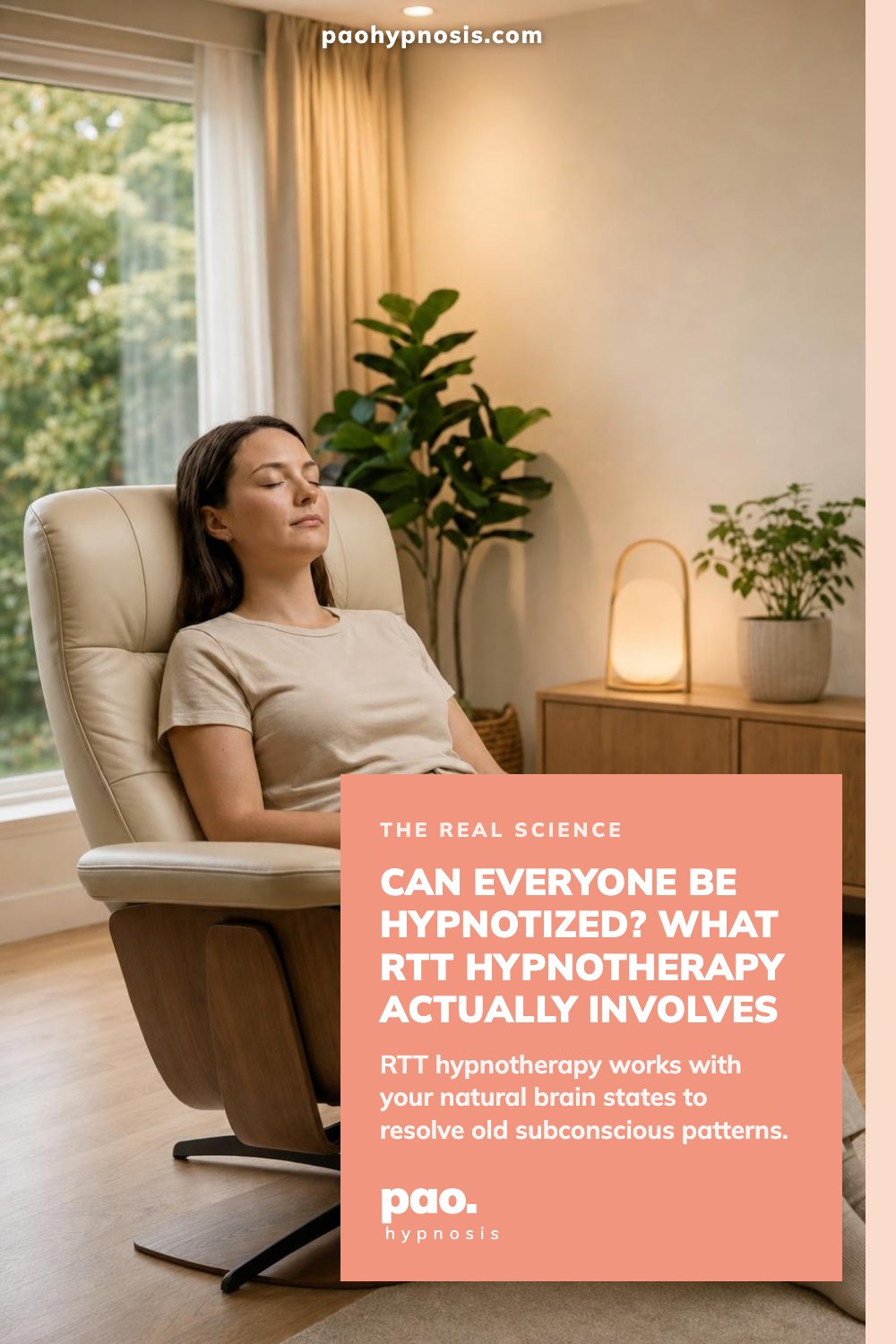
Can Everyone Be Hypnotized? What RTT Hypnotherapy Actually Involves
June 26, 2026 · By Paola Mendez, Certified RTT Hypnotherapist · Updated September 20, 2026
The short answer: almost everyone can be hypnotized. What stops most people isn't their brain, it's a misconception about what hypnosis actually is.
If you've ever gotten lost in a book, zoned out on a long drive, or found yourself absorbed in a movie so deeply that an hour passed without you noticing, you've already experienced something very close to a hypnotic state. Hypnosis isn't something that happens to you. It's a natural state your brain moves into on its own, every single day.
As a certified RTT (Rapid Transformational Therapy) hypnotherapist trained under the Marisa Peer method, the question I hear most often before a first session is: "But what if it doesn't work on me?" This post is my full answer to that question.
If you've been curious about RTT hypnotherapy but weren't sure whether it would work for you, I'd love to answer your questions directly.
Find Out If RTT Is Right for You: Book a Free Consult
What's in this article
The Stage Hypnosis Myth That's Holding People Back
Stage hypnosis, the kind where someone in a tuxedo gets volunteers to bark like dogs in front of a laughing audience, has done enormous damage to what people believe about hypnotherapy. It's entertainment, not therapy. The two are about as related as a comedy movie is to emergency surgery.
Stage hypnosis works by selecting highly suggestible volunteers, using social pressure and the desire to perform, and then giving people permission to do silly things they probably wouldn't mind doing anyway. There's no depth of trance required. No healing happens. Nobody's subconscious is being accessed or changed.
RTT hypnotherapy is the opposite of all of that. You're fully clothed. You're on a video call or in a private therapy room. I'm not trying to make you do anything. I'm working with you to help you understand and update the beliefs your subconscious formed, often in childhood, that are running your behavior now. You are in control the entire time. You can open your eyes, speak, and end the session whenever you choose.
What Hypnosis Actually Feels Like
The most common thing clients say after their first RTT session is: "I thought I was going to feel different, but I felt completely normal. I was aware of everything." That surprises most people. They expected to go blank or wake up with no memory of what happened.
What hypnosis feels like is closer to a very deep state of relaxation, similar to the moments just before you fall asleep, when your body has let go but your mind is still present. Your awareness doesn't disappear. You can hear me, respond to me, and you'll remember the session afterward. Some clients describe it as feeling calm and floaty. Others say they felt very focused and present. Both are completely normal.
What changes in that state is that your analytical, critical mind, the part that second-guesses everything, quiets down. This allows access to the subconscious, where your deep beliefs, patterns, and emotional memories live. That's the layer RTT works on. Not behavior. Not willpower. The underlying program.
RTT vs. Traditional Hypnotherapy: What's Different
Traditional hypnotherapy often uses direct suggestion: while you're relaxed, the therapist repeats positive affirmations to replace negative ones. It can be effective for certain things, but it doesn't always get to the root of why the pattern exists.
RTT, developed by Marisa Peer, goes deeper. It's a hybrid method that draws on hypnotherapy, CBT (Cognitive Behavioral Therapy), NLP (Neuro-Linguistic Programming), and psychotherapy. Rather than replacing a belief with a new one, RTT takes you back to the original scene where a belief was formed, often a childhood memory you may not have thought about in years, and gives you the adult perspective and understanding to reframe it at the source.
This is why RTT results tend to be faster and more lasting than approaches that only address the surface. You're not managing a pattern; you're understanding and releasing its origin.
RTT sessions are 90 minutes, with a custom audio recording you listen to for 21 days after. Most clients notice shifts within the first week.
I'm Ready to Try RTT: Book My Session
Is Hypnotherapy Safe? What You're Actually in Control Of
Yes. Hypnotherapy is safe, and more importantly, you remain in control throughout the entire session.
A few things that are true in every RTT session, without exception:
You cannot be made to do or say anything against your will. The hypnotic state doesn't remove your agency. If I asked you to do something that conflicted with your values, your subconscious would simply reject the suggestion and you would come out of the relaxed state.
You can end the session at any point. If you feel uncomfortable for any reason, you can open your eyes and stop. This has never happened in my practice (clients usually don't want to leave the relaxed state), but the option is always there.
You won't reveal things you don't want to share. RTT is client-led. I guide the process, but you decide what you share and what you keep private. Some clients speak in detail about what they're experiencing; others process things internally and give me brief summaries. Both work.
You won't get "stuck" in hypnosis. This is a common fear and a complete myth. You cannot become trapped in a hypnotic state. At worst, if the session were interrupted, you would either continue to relax naturally into sleep or simply emerge on your own within moments.
Hypnotherapy is not recommended for people with certain psychiatric conditions including schizophrenia, severe personality disorders, or active psychosis. If you're unsure whether RTT is right for you given your medical history, I always recommend discussing it with your primary healthcare provider first.
Who Benefits Most from RTT
RTT works best for people who are dealing with a pattern they can't seem to break through willpower alone. This includes emotional eating and food anxiety, chronic stress or anxiety, low self-worth or confidence issues, sleep problems, phobias, smoking, and chronic pain that has a psychosomatic component.
What these have in common: they're not behavioral problems. They're subconscious programs: beliefs formed early in life that your nervous system is still running, even when your conscious mind knows they're not true or useful. Willpower addresses behavior. RTT addresses the program underneath it. This is also why anxiety can strike seemingly out of nowhere: the subconscious is running a program that your conscious mind didn't choose.
The clients who get the most from RTT tend to be open to the process: not necessarily believers going in, but willing to try. Some of my most powerful results have come from self-described skeptics who came in curious but doubtful and left changed.
What Happens in an RTT Session
An RTT session with me runs approximately 90 minutes. Here's how it unfolds:
Before the session: We have a brief conversation about what you'd like to change and what's brought you to RTT. I explain what to expect so there are no surprises.
The induction: I guide you into a relaxed state using a gentle visualization process. Most clients are surprised by how quickly and easily this happens. The brain is naturally inclined toward relaxation when given permission and guidance.
Regression: Together we visit two or three scenes from your past, memories your subconscious has filed as significant, to understand where the belief or pattern originated. You're the observer, not the participant. You watch from a safe distance and share what you see.
Transformation: I help you reframe what you observed, updating the meaning your younger self attached to those experiences with the perspective and understanding you have now as an adult.
The recording: I create a personalized audio recording for you to listen to every day for 21 days after the session. This is what cements the new belief in your subconscious. Repetition in a relaxed state is the fastest way to update a deep program.
After: Most clients notice shifts within the first week. Some changes are immediate. Some unfold gradually as the recording continues to work. I check in with clients after the 21-day listening period.
A single RTT session is 90 minutes. Most clients notice real changes within the first week of listening to their recording.
Start the Process: Book Your RTT Session
Frequently Asked Questions
Can everyone be hypnotized?
Almost everyone can enter a hypnotic state. It's a natural state of your mind, not a special ability. The people who have the most difficulty are those who are highly resistant to relaxing or who approach the session with strong conscious interference (trying to analyze everything as it happens). Even then, with the right guidance, most people can access a useful level of relaxation. The small percentage who don't respond well to hypnosis tend to be people with certain psychiatric conditions, which is why I do a brief intake before every session.
What if I can't relax enough to be hypnotized?
The ability to enter hypnosis has nothing to do with how well you relax in everyday life. Some of my most tightly wound, analytical clients go into the deepest states because once they're guided there and given permission to let go, the relief of relaxing is profound. The induction process I use is specifically designed to work with a busy mind, not against it.
Will I remember what happens during the session?
Yes. Unlike general anesthesia or deep sleep, hypnosis doesn't erase memory. You'll be aware throughout and will remember the session afterward. Some clients find that certain details become clearer over the following days as they continue to process what came up; especially during the regression portion.
Is RTT hypnotherapy the same as stage hypnosis?
Not at all. Stage hypnosis is entertainment. It uses social pressure and volunteer selection to create a performance. RTT is a clinical therapeutic method developed by Marisa Peer, combining hypnotherapy with CBT (Cognitive Behavioral Therapy), NLP, (Neuro-Linguistic Programming) and psychotherapy to address the subconscious roots of behavioral and emotional patterns. The two are completely unrelated in purpose, depth, and process.
Can you make me do something I don't want to do while I'm hypnotized?
No. Your values and sense of self remain fully intact during hypnosis. If I suggested something that conflicted with your beliefs or wishes, your subconscious would reject it and you would naturally come out of the relaxed state. RTT is a collaborative process. I guide, you lead. Nothing happens without your participation and willingness.
How is RTT different from talk therapy?
Talk therapy primarily works with the conscious mind. You discuss, analyze, and develop insight into your patterns over many sessions. RTT bypasses the conscious mind's critical factor and works directly with the subconscious, where the original beliefs and emotional memories are stored. This is why RTT typically achieves significant results in one to three sessions rather than months or years of weekly appointments.
How many RTT sessions will I need?
Most issues are addressed in one to three sessions. A single 90-minute RTT session, followed by 21 days of listening to your personalized recording, is enough for most clients to experience meaningful, lasting change. Complex or layered issues, particularly those involving long-standing trauma or multiple interrelated patterns, may benefit from a second or third session.
Do you offer RTT sessions online?
Yes. RTT works just as effectively via video call as it does in person. I see clients both in my Miami office and remotely. All you need is a quiet space, a reliable internet connection, and somewhere comfortable to sit or lie down.
About the Author: Paola MendezPaola Mendez is a certified RTT (Rapid Transformational Therapy) hypnotherapist, trained under the Marisa Peer method. She is also a certified yoga teacher and holds an MS in Management of Information Systems and a BS in Computer Science and Mathematics. Before becoming a hypnotherapist, Paola spent over a decade as a software developer and built The Blogger Union, a creator community with 12+ chapters across the US. She sees clients in person in Miami and remotely worldwide through her practice, Pao Hypnosis, and is the founder of Mochi Zen, an RTT-based weight loss app. As featured in Nora Magazine and Coral Gables Magazine.