How to Stop Sugar Cravings Using Hypnotherapy
March 4, 2026 · Paola Mendez
Table of Contents
Sugar cravings are one of the most common things I hear about from clients. They've tried cutting sugar completely. They've tried "just having a little." They've tried going cold turkey after every holiday, every Monday, every fresh start. And for a while it works — until it doesn't, and they're right back where they started, feeling like they have no self-control.
Here's what I tell every client who sits across from me: sugar cravings are not a willpower problem. They are a subconscious pattern — and until you address them at that level, no diet, no substitution, and no amount of discipline will make them stop for good.
As a certified hypnotherapist and Rapid Transformational Therapy (RTT) practitioner trained by Marisa Peer, I've worked with many women to address the subconscious beliefs and emotional patterns driving their relationship with sugar. This article explains exactly how that works — and why it's so much more effective than anything else they've tried.
Ready to address your sugar cravings at the root?
Book a Private RTT Session with Paola →
One-on-one hypnotherapy tailored specifically to your relationship with food and sugar.
Why Sugar Cravings Are So Hard to Control
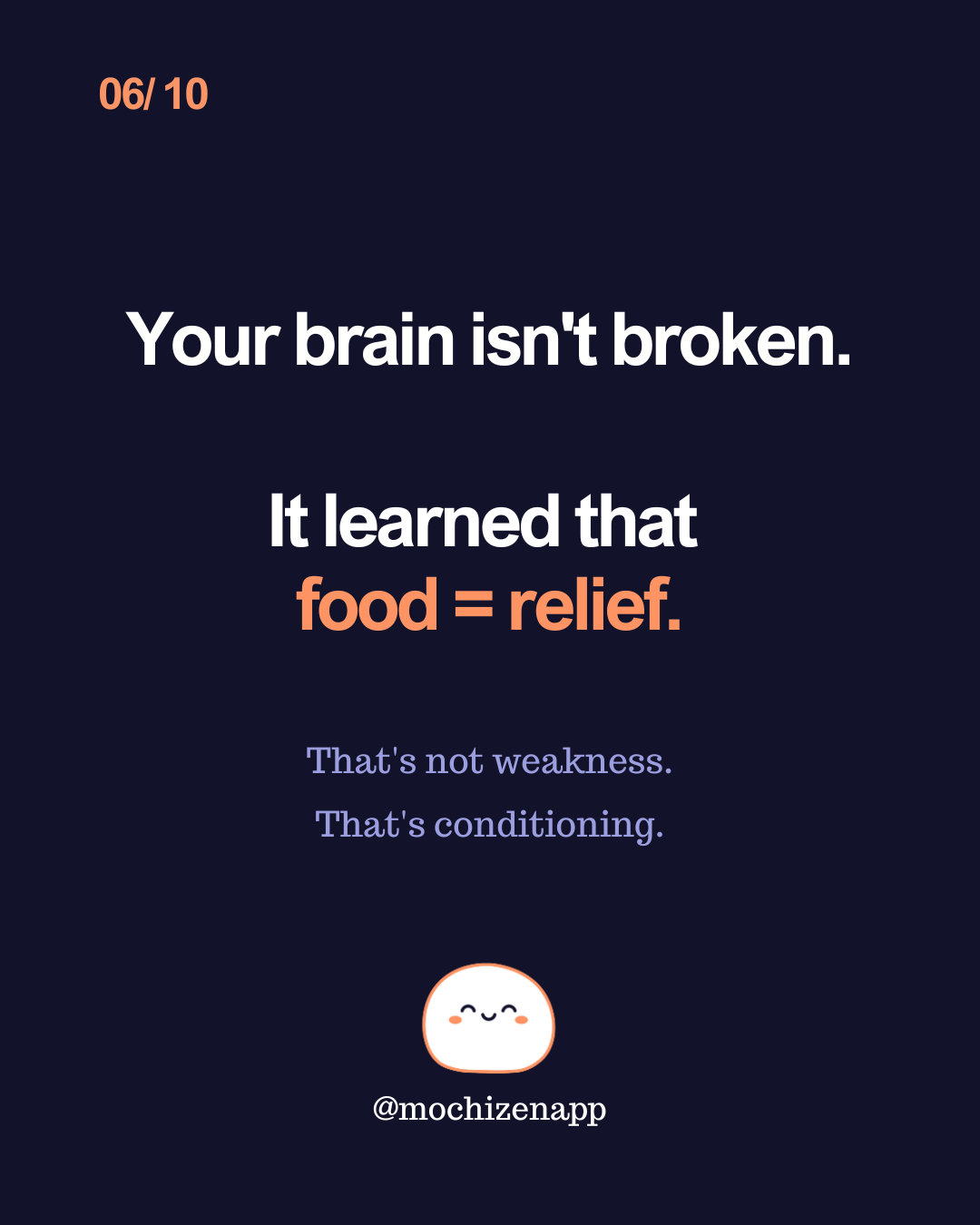
Source: How To Get Over Binge Eating - Mochi-Zen.com
Sugar is not just a taste preference — it's a neurological event. When you eat sugar, your brain releases dopamine, the feel-good neurotransmitter associated with pleasure and reward. Over time, your brain begins to associate sugar with relief, comfort, and reward — and starts to seek it out, especially when you're stressed, depleted, or emotionally overwhelmed.
This is why sugar cravings feel so urgent and so hard to resist. You're not fighting a preference. You're fighting a dopamine-driven feedback loop that your brain has been reinforcing, potentially for years.
The physical dimension of cravings is also real. Cortisol — the stress hormone — directly increases appetite for high-sugar foods. When you're chronically stressed (and most of my clients are), your body is constantly primed to crave sugar as a quick source of energy and emotional relief. According to the National Institutes of Health, stress-related eating is one of the leading drivers of overconsumption of sugar and processed foods.
Add to this the blood sugar rollercoaster — where restriction leads to a drop, which leads to intense cravings, which leads to overconsumption, which leads to a spike and crash — and you have a cycle that willpower alone has no realistic hope of breaking.

The Emotional Root of Sugar Cravings
Here's what most nutritionists and diet programs don't address: for the majority of my clients, sugar cravings aren't primarily physical. They're emotional.
Sugar is deeply woven into our emotional histories. Think about how many significant memories and feelings are connected to sweet foods — birthday cakes, holiday treats, being given candy as a reward or comfort as a child. For many people, sweetness became associated early in life with love, safety, celebration, and comfort.
Your subconscious mind holds all of those associations. When you're stressed, lonely, bored, or in need of comfort as an adult, your subconscious reaches for what it learned to reach for — something sweet. This is not a character flaw. It is a conditioned response, and it can be changed.
In my RTT practice, I frequently find that sugar cravings are connected to:
A need for comfort or emotional soothing that isn't being met elsewhere
A reward pattern — using sugar as a treat after effort or stress
A childhood association between sweet food and feeling loved or safe
A stress-relief mechanism that developed when no other tools were available
Once we identify the specific root in a session, the craving often loses much of its power — because the subconscious understands where it came from and no longer needs to run the old program.
Why Cutting Out Sugar Doesn't Work Long-Term
Restriction is the most common approach to sugar cravings — and the least effective one over time. Here's why.
When you tell your brain that sugar is forbidden, you trigger a scarcity response. Forbidden things become more desirable, not less. The more mental energy you spend trying not to think about sugar, the more your brain thinks about sugar. This is sometimes called the white bear effect — the harder you try to suppress a thought, the more insistently it returns.
Restriction also intensifies the emotional charge around sugar. When you finally "give in," the guilt and shame that follow often lead to more eating, not less. The all-or-nothing cycle accelerates.
What actually works is not fighting the craving from the outside — it's changing the internal programming that generates the craving in the first place. That's precisely what RTT hypnotherapy is designed to do.
Prefer to work on this between sessions — or start before booking?
Try Mochi Zen Free for 7 Days →
The Mochi Zen app by Paola Mendez combines RTT-based hypnotherapy audio sessions with AI nutrition tracking — an accessible complement to private RTT work, or a powerful starting point on its own.

What RTT Hypnotherapy Is — And How It Addresses Cravings
Rapid Transformational Therapy (RTT) is a methodology developed by world-renowned therapist Marisa Peer, combining the most effective elements of hypnotherapy, Neuro-Linguistic Programming (NLP), Cognitive Behavioral Therapy (CBT), and psychotherapy into a focused, results-oriented approach.
RTT works by guiding the client into a deeply relaxed, hypnotic state — not unconscious, but highly receptive — and then working directly with the subconscious mind to identify and update the beliefs and patterns driving the unwanted behavior. In the case of sugar cravings, this means finding the root of the emotional association with sugar and replacing it with a new, healthier response.
The research supports this approach powerfully. A landmark study by Kirsch, Montgomery, and Sapirstein (1995), published in the Journal of Consulting and Clinical Psychology, found that patients who used hypnotherapy as part of their treatment lost more than twice the weight of those who didn't — and those results were maintained at a two-year follow-up. (Source: PubMed)
In my experience as an RTT practitioner, the shift clients experience around sugar is often significant and relatively rapid. Not because hypnotherapy is magic — but because it works at the level where the behavior actually lives, rather than trying to override it from the surface.

Paola speaking at Parlay House and leading a live group hypnotherapy session in Miami
What to Expect in an RTT Session for Sugar Cravings
Many clients come to their first session wondering what hypnotherapy actually feels like. The short answer: nothing like what you've seen on television.
You remain fully aware and in control throughout the session. Hypnosis is simply a deeply relaxed, focused state — similar to the feeling of being absorbed in a book or a daydream — in which your subconscious is more accessible and receptive. You cannot be made to do or say anything against your will.
A typical RTT session for sugar cravings unfolds in several stages:
Intake and intention-setting
We begin by talking through your specific relationship with sugar — when the cravings hit, what they feel like, what you've tried, and what you most want to change. This helps me understand the emotional landscape before we go deeper.
Hypnotic induction
I guide you into a relaxed, hypnotic state using a gentle induction process. Most clients describe this as profoundly relaxing — many say it's the most relaxed they've felt in years.
Root cause exploration
In the hypnotic state, we explore the origins of your sugar cravings — often tracing them to specific memories, feelings, or beliefs that your subconscious has held for a long time. Understanding the "why" behind the craving, at the subconscious level, is often a powerful moment of release for clients.
Transformation and reprogramming
Once the root is identified and understood, we do the work of updating the subconscious belief — creating new associations, new responses, and new messaging that supports the change you want to make. This is delivered through carefully crafted therapeutic language while you're in the receptive hypnotic state.
Recording for reinforcement
Every client receives a personalized audio recording of their transformation session to listen to in the days and weeks following our work together. Repetition is key to lasting change — the recording reinforces the new subconscious programming until it becomes the new default.
Most clients see meaningful results with one to three sessions, depending on the depth and history of the pattern.
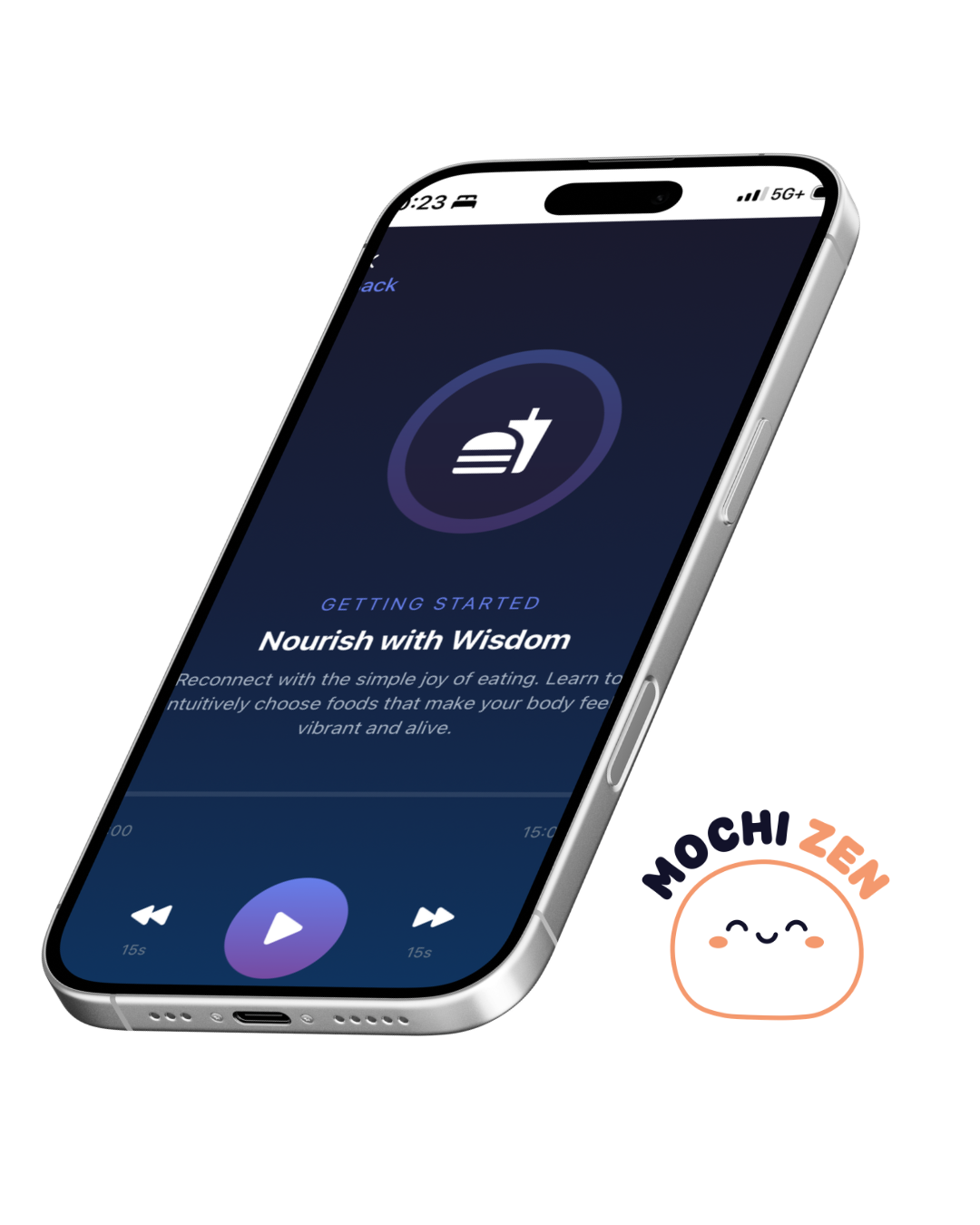
Can You Use Hypnotherapy
to Stop Sugar Cravings at Home?
Yes — and for many people, this is a powerful and accessible starting point: mochi-zen.com
Can You Use Hypnotherapy for Sugar Cravings at Home?
Yes — and for many people, this is a powerful and accessible starting point.
The Mochi Zen app, which I developed as an extension of my RTT practice, offers RTT-based hypnotherapy audio sessions specifically designed to address emotional eating, food cravings, and the subconscious patterns that drive them — available on iOS, and web, for use whenever and wherever you need them.
For women who want to begin working on their sugar cravings immediately, or who want to reinforce and extend the work done in private sessions, Mochi Zen is a natural complement. The app also includes AI-powered nutrition tracking, so you can address both the emotional root and the practical food awareness side in one place.
That said, private RTT sessions offer something the app cannot — the depth of personalized, one-on-one work that goes directly to your specific root cause. For complex or longstanding patterns, working with a practitioner is always the most powerful path.
Related: How to Stop Overeating for Good — The Root Cause No One Talks About
When to Seek Professional Support
If your relationship with sugar feels compulsive, is causing significant physical or emotional distress, or is part of a broader pattern of disordered eating, working with a qualified professional is the right step — not a sign of weakness. Eating patterns that have been in place for years often need deeper, personalized work to shift fully.
I work with women one-on-one through Pao Hypnosis to address the specific subconscious roots of their food patterns. If you're ready to stop managing your sugar cravings and start understanding them, I'd love to work with you.
Frequently Asked Questions
Can hypnotherapy really stop sugar cravings?
Yes — and it's one of the most effective approaches available for doing so sustainably. Unlike willpower or restriction, hypnotherapy addresses the subconscious beliefs and emotional associations driving the craving. Research by Kirsch et al. (1995) supports the effectiveness of hypnotherapy for weight-related behaviors, and many RTT clients experience a significant reduction in sugar cravings after just one to three sessions.
How many hypnotherapy sessions does it take to stop sugar cravings?
It varies by individual and the depth of the pattern. Many clients notice a meaningful shift after a single RTT session, particularly when the root cause is clearly identified and addressed. More complex or longstanding patterns may benefit from two to three sessions, plus consistent use of the personalized audio recording between sessions.
Is hypnotherapy for sugar cravings safe?
Yes. Clinical hypnotherapy is a safe, evidence-informed practice. You remain fully conscious and in control throughout the session. RTT, developed by Marisa Peer, is practiced by trained and certified practitioners worldwide and has been used effectively for a wide range of behavioral and emotional patterns including food-related issues.
What causes sugar cravings?
Sugar cravings have both physical and emotional causes. Physically, sugar triggers dopamine release and can create a reward loop in the brain. Stress hormones like cortisol also increase cravings for sweet foods. Emotionally, sugar is often tied to comfort, reward, and early childhood associations — which is why cravings tend to be strongest when we're stressed, lonely, or depleted.
Is there a difference between sugar cravings and sugar addiction?
The term "sugar addiction" is sometimes used informally to describe the compulsive quality of some people's relationship with sugar. While sugar does engage reward pathways in the brain similarly to addictive substances, it is not classified as an addiction in clinical diagnostic criteria. However, the experience can feel addiction-like, and the subconscious mechanisms involved respond well to the same kind of root-cause work used in addiction-focused therapy.
Can I use a hypnotherapy app instead of seeing a practitioner?
App-based RTT audio sessions — like those in the Mochi Zen app — are a powerful and accessible tool for working on food cravings and emotional eating. They work best for people whose patterns are moderate or as a complement to private sessions. For deeper or more complex patterns, working one-on-one with an RTT practitioner provides a level of personalization and depth that apps cannot replicate.
How is RTT different from regular hypnotherapy?
RTT, developed by Marisa Peer, is a specific methodology that goes beyond traditional hypnotherapy by actively identifying and transforming the root cause of the issue within the session — rather than simply delivering positive suggestions. It draws on multiple therapeutic modalities and is specifically designed to produce fast, lasting results. It also includes a personalized audio recording for reinforcement after the session.
About the Author
Paola Mendez is a certified hypnotherapist and Rapid Transformational Therapy (RTT) practitioner, trained in the methodology developed by Marisa Peer. Through her private practice Pao Hypnosis, she works one-on-one with women to address the subconscious patterns behind emotional eating, sugar cravings, and weight struggles. She is also the founder of Mochi Zen, a weight loss app combining RTT-based hypnotherapy with AI nutrition tracking for women who want to do this work on their own terms.
Ready to Stop Managing Your Sugar Cravings and Start Ending Them?
Book a private RTT session with Paola Mendez and address the subconscious root of your cravings — personally, one-on-one, and built around your specific history.
Book Your Private RTT Session →
⚠️ Health Disclaimer: The content in this article is for informational and educational purposes only and does not constitute medical advice. RTT hypnotherapy is a complementary approach and is not a substitute for professional medical or psychological treatment. If you are experiencing symptoms of an eating disorder or compulsive eating behaviors, please consult a qualified healthcare provider.