How to Quit Binge Eating: What Hypnotherapy Does That Diets Can't
March 5, 2026 · Paola Mendez

In This Article
You know exactly what you're doing when it starts. You're not even hungry. But something switches — a long day, a flash of anxiety, a thought you'd rather not sit with — and before you've registered it consciously, you're eating. Fast. And you can't seem to stop.
If this sounds familiar, you've almost certainly already tried the diet approach. You've tracked calories, cut carbs, removed trigger foods, done the meal prep, downloaded the apps. And for a while it worked — right up until it didn't.
That's not a discipline failure. That's a design failure. Diets were built to manage what you eat. They were never built to address why you eat the way you do when stress, loneliness, boredom, or anxiety shows up.
That's the gap that RTT hypnotherapy was built to fill.
I'm Paola Mendez, an RTT-certified hypnotherapist trained in the methodology developed by world-renowned therapist Marisa Peer. I work with women who have tried every conventional approach to binge eating and are ready to address the root cause. Here's what hypnotherapy does that diets simply can't.
You've spent years trying to control the binge. What if the answer is understanding it instead?
Why Diets Don't Fix Binge Eating
To understand why diets fail at binge eating, you need to understand where binge eating actually lives. It doesn't live in your stomach. It doesn't live in your calorie count or your meal plan. It lives in your brain — specifically in the subconscious patterns that were laid down long before any diet existed.
Think of your subconscious mind as a highly efficient autopilot system. Its entire job is to run familiar programs automatically so you don't have to think about them. Once a pattern is established — eating for comfort, eating to numb, eating as reward — the subconscious will run that program with remarkable consistency and very little regard for what your conscious, rational mind wants to do instead.
This is why willpower runs out. Willpower operates at the conscious level. The binge is operating at the subconscious level. Every time you white-knuckle your way through a craving using conscious effort, you're fighting against an automated system that has years of reinforcement behind it. That's not a fair fight.
Diets give you rules for your conscious mind to follow. They don't touch the subconscious programming. So the pattern stays, and the binge comes back — often with more force after a period of restriction.
What's Actually Driving the Binge
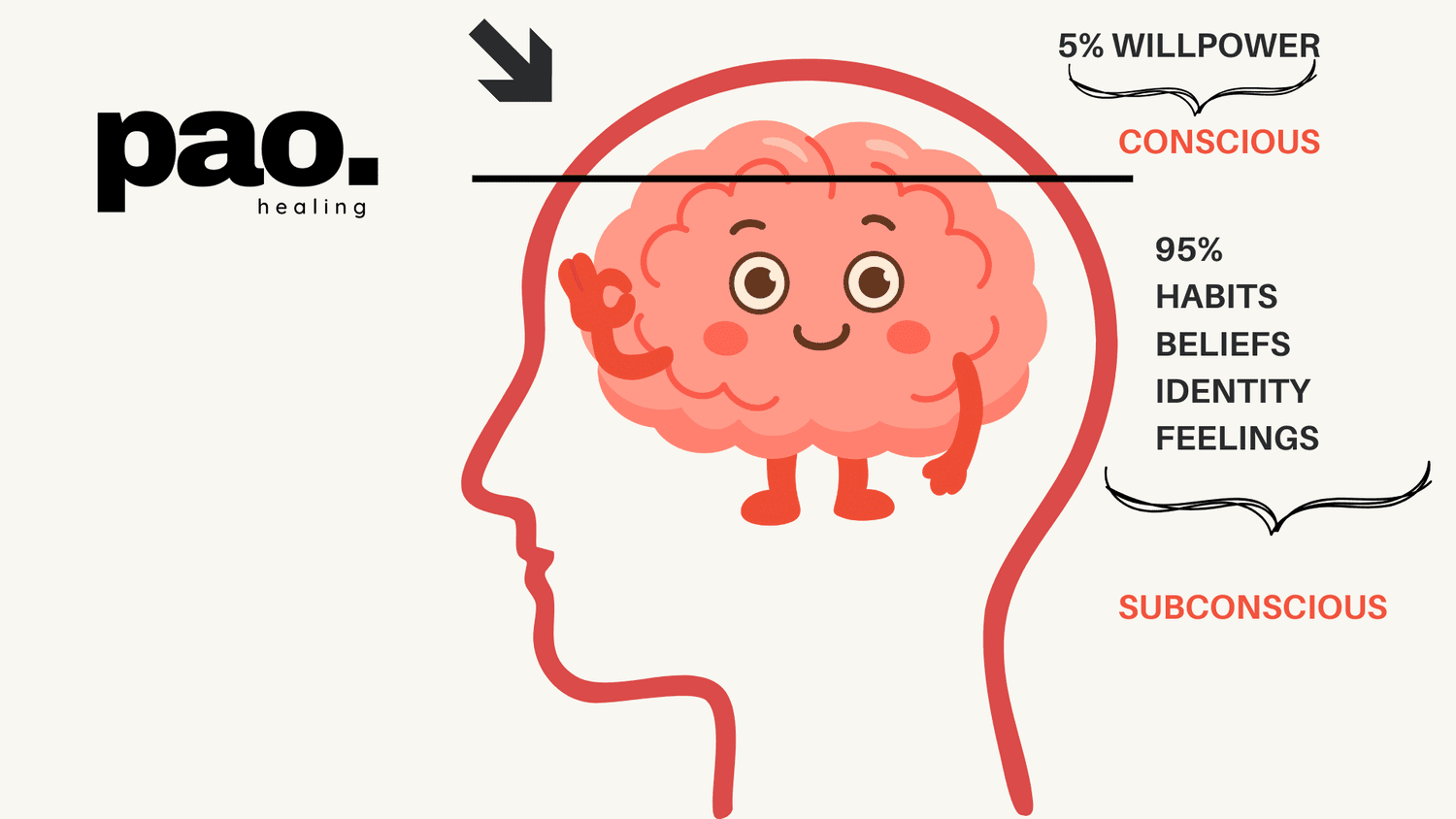
Source: Why Willpower is a Failing Strategy for High-Achievers: The Neuroscience of the 5% vs. 95%
When I work with a client on binge eating using RTT, we always begin with the same question: what does the binge actually do for you?
This isn't a trick question. Every behavior that persists does something. For most people who binge, the eating is serving a function — often one of the following:
Emotional regulation: Food changes the way your body feels when you're anxious, stressed, or overwhelmed. It works quickly and reliably. For someone who never learned another way to regulate difficult emotions, this is a powerful pattern.
Self-soothing: Comfort food is often connected to early experiences of being cared for. The binge may be a subconscious attempt to give yourself something you needed that you didn't always get.
Numbing: Food can interrupt uncomfortable thoughts and feelings. The act of eating — especially quickly, and with a lot of sensory input — is absorbing enough to stop the mind from going where it doesn't want to go.
Reward and self-permission: For people who follow rigid food rules, the binge often follows a period of "being good." There's a buried belief that deprivation earns reward, and when the conscious guard drops, the subconscious cashes it in.
None of these functions are visible on a calorie tracker. And none of them disappear because you followed a different meal plan this week.
To stop the binge eating, you have to understand what the binge is doing — and give the subconscious mind a better way to meet that same need. That's not something a diet can do. But it's exactly what hypnotherapy is designed to do.

What Hypnotherapy Does Differently
Hypnotherapy works by creating direct access to the subconscious mind. In a typical waking state, the conscious mind is active, analytical, and defensive — it filters and evaluates everything. This is useful in everyday life, but it also makes it very difficult to change deep-seated patterns. The conscious mind tends to rationalize, argue, and resist.
In a hypnotic state, that filter relaxes. You are fully aware, fully in control — hypnosis is not sleep, and it's not about losing your will. What changes is your receptivity. The subconscious becomes accessible in a way it usually isn't, which means that the patterns, beliefs, and memories that are running the binge can be identified, understood, and rewritten.
RTT (Rapid Transformational Therapy), the methodology developed by Marisa Peer and the framework I trained in, combines hypnotherapy with elements of cognitive and behavioral work. It's not passive listening. In an RTT session, we go looking for the root cause — the specific events, conclusions, and beliefs that set the binge pattern in motion — and we change the meaning attached to them.
The result isn't suppression. You're not teaching yourself to white-knuckle harder. You're updating the program that was running the behavior in the first place. When the subconscious no longer needs the binge to meet an emotional need, the pull toward it changes significantly — often in ways that feel surprising and effortless compared to every diet you've ever tried.
For more on how this works specifically with sugar and cravings, read: How to Stop Sugar Cravings Using Hypnotherapy.
Ready to understand what your binge has been trying to tell you?
A discovery call with Paola is the first step toward working on the actual root cause.
What RTT Hypnotherapy Sessions Look Like for Binge Eating
A lot of people come to me having avoided hypnotherapy for years because they weren't sure what to expect. The gap between what hypnotherapy is on a stage show and what it is in a clinical, RTT-based session is significant. Here's what actually happens.

The Initial Consultation
Before any hypnotherapy begins, we spend time talking. I want to understand the full picture of your binge eating pattern — when it started, what tends to trigger it, what you've already tried, and what the binge gives you (or seems to give you). This isn't a judgment. It's a map.

The RTT Session
An RTT session typically runs 90 minutes to two hours. You'll be guided into a comfortable, relaxed state — similar to the feeling right before you fall asleep, where the mind is quiet but aware. From there, we use a process of regression and exploration to identify the specific beliefs and experiences that are driving the binge pattern.
Clients often describe this as genuinely surprising. The connection between a long-forgotten experience and a current eating pattern becomes clear in a way that no amount of conscious analysis had revealed before. That clarity is significant, because the mind can only work with what it understands.

The Transformation
Recording
After each session, you receive a personalized audio recording — typically 20–25 minutes — built specifically around the patterns we uncovered in your session.
The Transformation Recording
After each session, you receive a personalized audio recording — typically 20–25 minutes — built specifically around the patterns we uncovered in your session. You listen to this recording daily for 21 days. This is the reinforcement phase: the subconscious needs repetition to consolidate new patterns, just as it needed repetition to build the old ones.
If you're looking for a way to combine RTT-based hypnotherapy with daily nutrition tracking and accountability in an app, Mochi Zen was built for exactly this — RTT-based audio sessions alongside AI-powered meal logging and a daily journal. It's a natural complement to private RTT work for those who want continued support between sessions.
What the Research Says
Hypnotherapy as a clinical tool has research behind it, including a landmark meta-analysis published in the Journal of Consulting and Clinical Psychology by Kirsch, Montgomery, and Sapirstein (1995). The study found that patients who received cognitive-behavioral therapy combined with hypnotherapy lost more than twice as much weight as those who received CBT alone — and those results held at two-year follow-up.
This matters for binge eating specifically because the study wasn't measuring simple caloric restriction. The patients using hypnotherapy were changing their relationship with food at a deeper level — which is what allowed the results to persist long after the sessions ended.
The National Institute of Mental Health recognizes binge eating disorder as one of the most common eating disorders in the US, affecting millions of adults — many of whom cycle through conventional approaches without lasting relief. The research increasingly points to the importance of addressing the psychological and emotional drivers of the behavior, not just the eating behavior itself.
Real Results: What Clients Experience
The changes clients describe after RTT work for binge eating are often different from what they expected going in. They expected to feel more "in control." What they often describe instead is feeling less at war.
The urgency around food changes. The compulsion that used to feel almost physical starts to feel more optional. One client described it as: "It's like I finally understood what was happening, and once I did, it stopped having the same power."
Others describe a shift in how they respond to difficult emotions. Without the subconscious program running food as the default coping tool, they find other responses coming more naturally — without effort, without forcing it.
This is what the RTT process is designed to produce: not a gritted-teeth version of "not bingeing," but a genuine reduction in the pull toward it. Not willpower — understanding. Not suppression — transformation.
You can read more about the binge eating cycle from a different angle over at this article on the Mochi Zen blog, which covers what keeps the pattern locked in and what it takes to break it.
How to Get Started
If you've been dealing with binge eating for a while, you've probably had the experience of starting something new, feeling hopeful, and then finding yourself back at the same place. I understand why that makes it hard to try again.
The reason RTT is different is not because it's harder, or because it requires more discipline. It's because it works at a different level than anything you've tried before. It's not asking your conscious mind to override your subconscious. It's asking the subconscious to update its own programming.
The first step is a discovery call — a conversation where we talk about what's been happening, what you've already tried, and whether RTT is a good fit for you. There's no obligation and no pressure. It's simply a chance to understand what working together would look like.
You've spent years trying to control this. What if you could understand it instead?
Book a free discovery call with Paola Mendez, RTT-certified hypnotherapist trained by Marisa Peer.
Frequently Asked Questions
Can hypnotherapy really stop binge eating?
Hypnotherapy doesn't "stop" binge eating in the way a diet tries to stop it through restriction. What it does is address the subconscious pattern that drives the binge in the first place. When the underlying emotional need being met by the binge is identified and resolved, the compulsion to binge typically reduces significantly. Research, including the Kirsch et al. 1995 meta-analysis, supports hypnotherapy as an effective complement to behavioral approaches for weight and eating concerns.
How is RTT hypnotherapy different from regular hypnotherapy?
RTT (Rapid Transformational Therapy), developed by Marisa Peer, combines hypnotherapy with elements of cognitive and behavioral therapy. Where traditional hypnotherapy might use suggestion alone, RTT uses regression to identify the specific root experiences and beliefs driving a pattern, then actively works to change the meaning attached to them. Most clients experience noticeable shifts within one to three sessions, and each session comes with a personalized transformation recording to reinforce the work.
Is hypnotherapy safe for binge eating disorder?
RTT hypnotherapy is a complementary approach. If you have a clinical diagnosis of binge eating disorder (BED), hypnotherapy works best alongside — not instead of — any treatment recommended by your medical team. Always consult your doctor or a licensed mental health professional if you have concerns about your eating behavior. That said, RTT sessions are gentle, non-invasive, and focused on understanding rather than confrontation.
How many sessions does it take to see results with binge eating?
Many clients notice significant shifts after just one RTT session, particularly when combined with daily listening to their personalized recording for 21 days. More complex or longstanding patterns may benefit from two or three sessions. During your discovery call, we'll discuss what a realistic timeline looks like for your specific situation.
What if I've already tried therapy for binge eating and it didn't work?
Many clients come to RTT after years of therapy, medication, or behavioral programs without lasting results. This is actually one of the most common starting points. The reason RTT often helps when other approaches haven't is that it works at the subconscious level — the level where the behavior is actually being generated. Conscious insight (knowing why you binge) doesn't automatically change the subconscious pattern. RTT specifically targets that gap.
Will I lose weight if I stop binge eating with hypnotherapy?
For many people, yes — though weight loss isn't the direct goal of RTT for binge eating. The goal is to resolve the compulsive eating pattern and the emotional drivers behind it. When that resolves, eating becomes more intuitive, portions naturally regulate, and the cycle of restrict-binge-restrict is interrupted. If you're also interested in tracking your nutrition alongside RTT work, Mochi Zen combines RTT-based audio sessions with AI-powered nutrition tracking — designed for exactly this kind of integrated support.
Do I have to relive traumatic memories during hypnotherapy?
RTT uses regression to revisit past experiences, but this is always done gently and with the client in full control. You are aware throughout and can stop or redirect at any time. Many clients are surprised by how calm and even curious they feel during regression — the hypnotic state naturally changes your emotional distance from difficult memories, making it possible to understand them without being overwhelmed by them.
How is hypnotherapy for binge eating different from using a weight loss app?
A weight loss app tracks what you eat. Hypnotherapy works on why you eat the way you do. Both serve real purposes — which is why many clients choose to combine them. If you want both in one place, Mochi Zen was designed specifically around this combination: RTT-based hypnotherapy sessions alongside AI nutrition tracking, built by a practitioner who understands that the mindset piece and the tracking piece have to work together.
About the Author
Paola Mendez is a certified RTT (Rapid Transformational Therapy) hypnotherapist, trained in the methodology developed by world-renowned therapist Marisa Peer. She specializes in working with women who struggle with emotional eating, binge eating, and chronic dieting — helping them resolve the root cause rather than manage the symptoms. Paola is also the founder of Mochi Zen, the weight loss app combining RTT-based hypnotherapy with AI nutrition tracking.